News · Sunderland, England.
The Man, the Messiah, the Moment
Bob Stokoe at the Stadium of Light
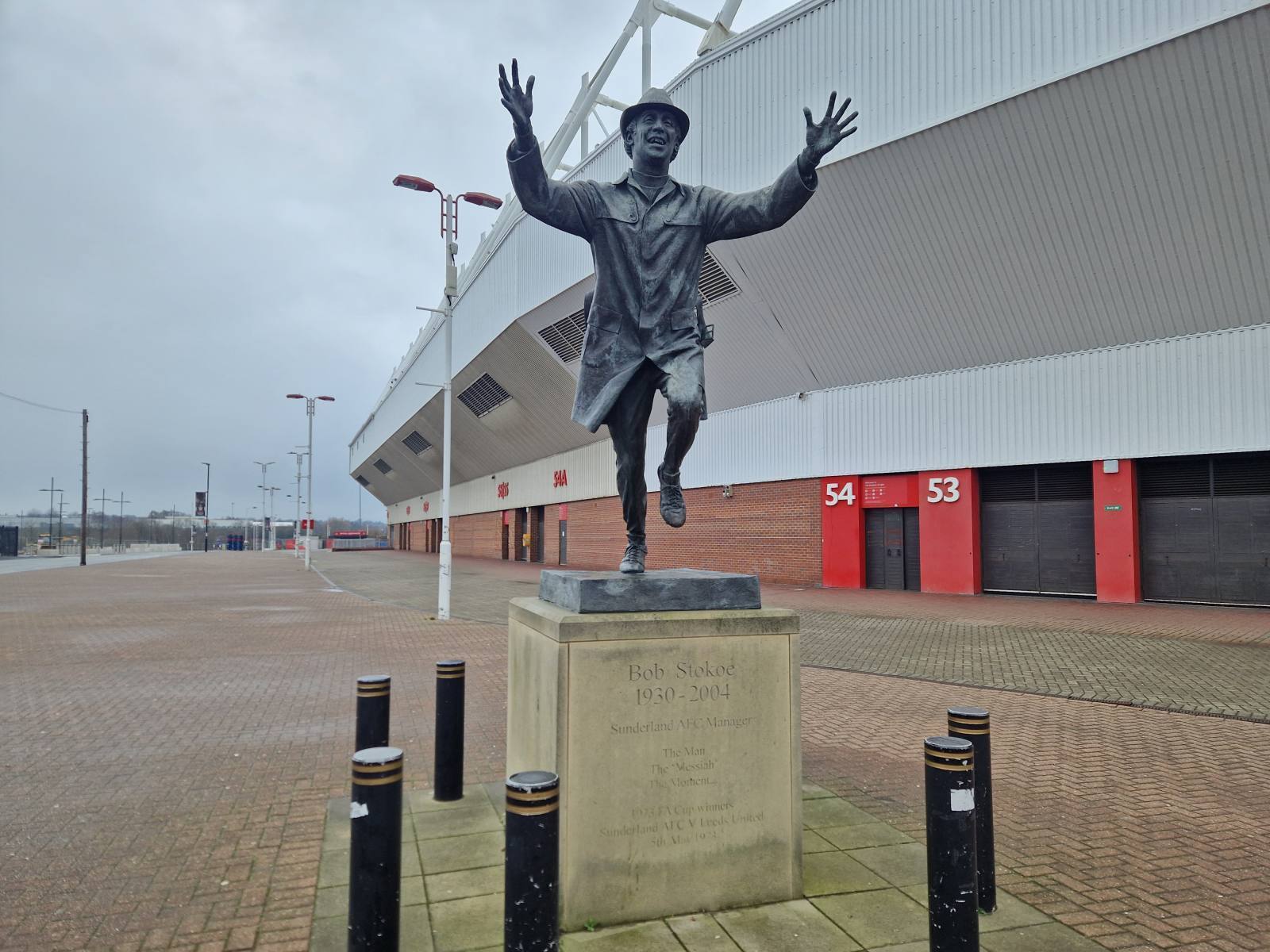
Arms out. Trilby on. Coat flying. One foot still in the air.
On a grey afternoon outside the Stadium of Light the bronze does what the man did at Wembley on 5 May 1973: it runs toward the celebration and never quite lands.
The plinth is plain and exact.
Bob Stokoe
1930–2004
Sunderland AFC Manager
The Man
The “Messiah”
The Moment…
1973 FA Cup winners
Sunderland AFC v Leeds United
5th May 1973
That is the whole story, cut into stone. Everything else is memory.
The moment the statue froze
Second Division Sunderland against Don Revie’s Leeds. Leeds were the holders, full of internationals, expected to walk it. Sunderland had been third from bottom when Stokoe took the job in November 1972. Six months later they were at Wembley.
Ian Porterfield scored. Jimmy Montgomery made the double save that still gets replayed whenever anyone talks about the club. The final whistle went. Stokoe, in the red tracksuit, the raincoat and the famous hat, did not wait for the tunnel. He ran.
He ran past his own outfield players and went straight for Montgomery. That is the image Wearside kept. Sculptor Sean Hedges-Quinn worked from film and stills. He set the hands on Stokoe’s watch to 16:50 — the time the whistle blew. The statue was unveiled on 18 July 2006 by Stokoe’s daughter, Karen Craven, after supporters raised the money themselves.
On the back of the plinth is the line he gave the day before the final:
“I didn’t bring the magic. It’s always been here… I just came back to find it.”
The man before the Messiah
Robert Stokoe was born on 21 September 1930 at Mickley Square, near Prudhoe — mining country, Sunderland-supporting household, even though he would later pull on a Newcastle shirt. He signed for the Magpies as a teenager, played more than 250 games, and won the FA Cup with them in 1955. Then he became a manager: Bury, Charlton, Rochdale, Carlisle, Blackpool.
When Sunderland called, the club was drifting. Crowds were down. Belief was thinner than it should have been for a club with Sunderland’s history. Stokoe put the black shorts back on the strip, talked as if the place still mattered, and the team started to play as if it did. Man City went. Arsenal went. Then Leeds.
They called him the Messiah of Roker Park because that is what it felt like: someone who had walked in from the wilderness and found the old faith still under the seats.
He later won the Second Division title and took the club back to the top flight. He left in 1976, came back briefly as caretaker in 1987, and died on 1 February 2004, aged 73.
Why this corner of the ground still matters
The statue stands at the south-west of the Stadium of Light, on the brick concourse between the red doors marked 54 and 53, under the white overhang of the stand. Matchdays it is a meeting point. Quiet days it is just a man mid-stride, coat tails out, smiling into weather that is usually the same colour as the photograph.
The club is now building Legends’ Way, a path that will turn the Stokoe statue toward a new statue of Jimmy Montgomery, so the two of them run at each other again the way they did when the cup was won. The old “Welcome to Sunderland” sign from Roker Park is due to stand nearby. The 1973 story is being given a street of its own.
Until then, this is the version we already have: one man, one second after the whistle, cast so it cannot fade.
If you were at Wembley, or in the streets when the bus came home, or only ever knew him as the bronze outside the ground, Sunderland View would like the memory.
Where were you when Stokoe ran?
Liberty Lux News